
Hello!
Autumn Miranda
Game Programming Major, Minor in Mathematics
Featured Game Projects


Projects


Gameplay Programmer | Trick Mechanics
My Pet Flesh Monster is a pet care game produced by a team of 9 students during the Spring '25 semester.I worked on this game as one of the programmers, and mainly contributed to the "Pet Show / Contest" portion of the game. I created the trick mechanics that the game used, and wrote the logic that ran the contests.

Lead Programmer | Tools & Repository Management
Soul Vault is a puzzle game with survival elements, produced by a team of 8 students in the Fall '25 semester.For this project I was the only programmer on the team, and mainly focused on managing the team's repository and creating modular systems for the designers to use to create enemies and puzzles.For the puzzle system specifically, I designed an interface class that could be connected to any of the puzzles, so that they could all be interacted with using the same functions.For the enemy system, I created an abstract base class that the designers could use as a template when creating new enemies. This allowed all enemies to be referenced through the Enemy Class, while having their own unique behaviors.
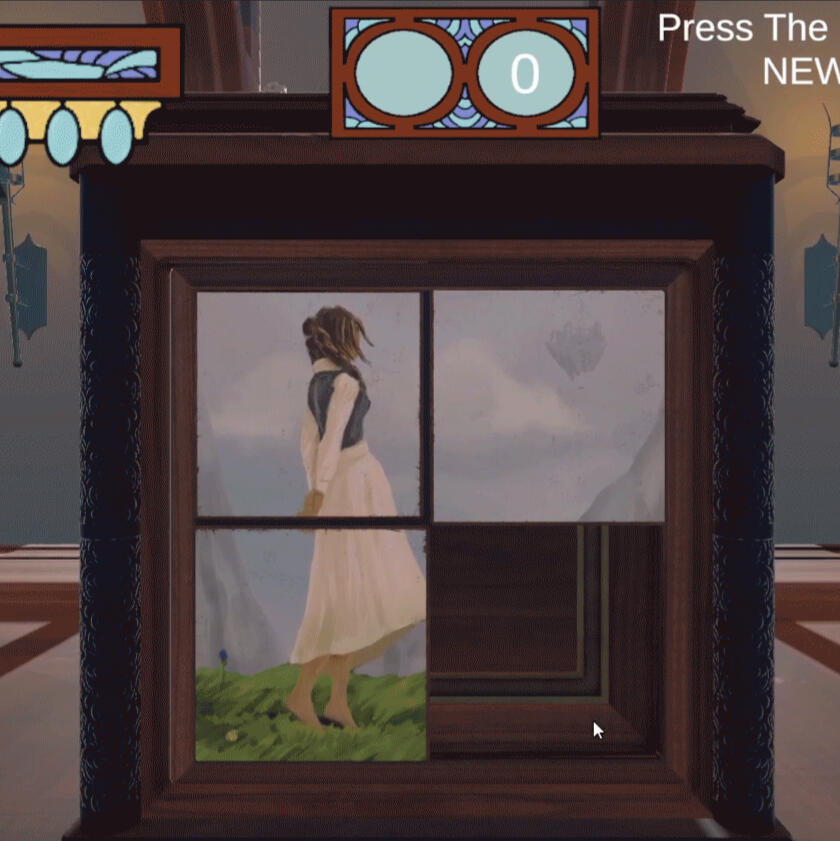
Working on this project made me more mindful as a programmer. Since I was working with many designers with varying levels of familiarity with programming, I had to be careful about the layout of my code and the documentation I created about it so that it would be useful to them. As an example, I tend to prefer to write single line conditional statements, but one of the designers on the team found them hard to read. I went back into the code and spaced out those lines out for them, so that they would have an easier time reading and understanding my code. I also focused on being descriptive with the names of variable and functions so that the code would be more readable, even without extra comments in it.

Gameplay & Systems Programmer | Boss Battle Mechanic
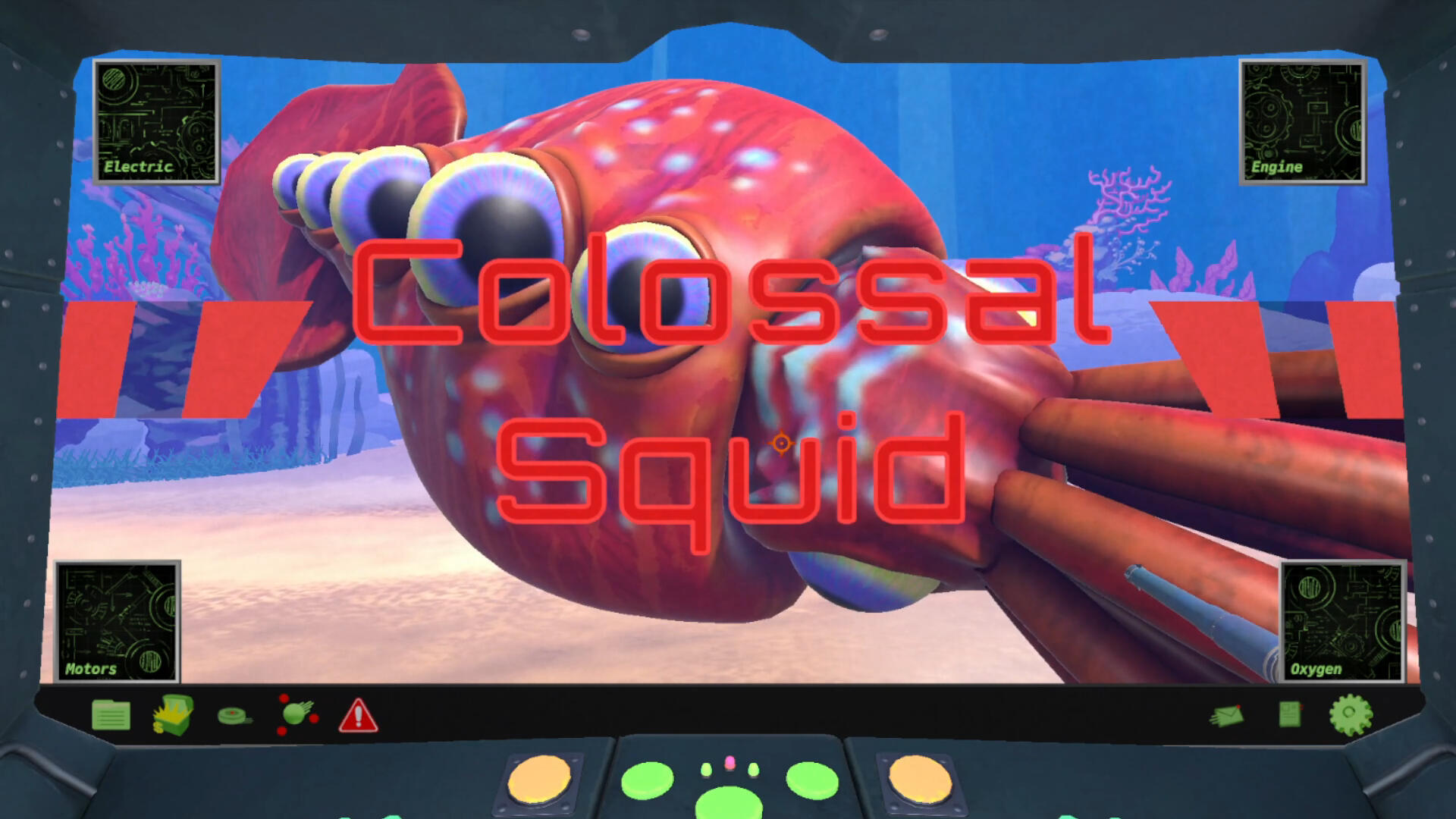
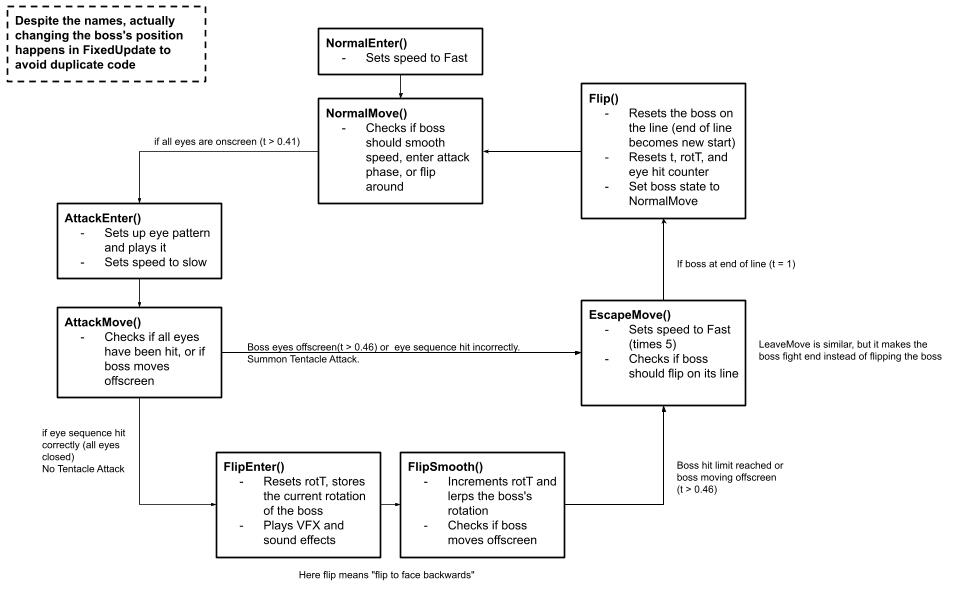
FinCrementalOS is a hybrid incremental-fish-shooter and simulated operating system, created by a team of 12 students over the course of 2 semesters (Fall '25 - Spring '26). I joined the team as a programmer during the game's second semester of production.For this project I worked with the team's designers and artists to implement a Boss Battle that would fit into the aesthetic of the game and connect well to the pre-existing code.
To create the Boss logic, I developed a simple state machine using delegates that runs through each stage of the fight. Although I was familiar with how state machines worked, this was my first time actually programming one in Unity.

Solo Project | Magnavox Odyssey Table Tennis Recreation
This was a project I did over the course of 3 years as a work study. It focused on trying to recreate the game "Table Tennis" from the Magnavox Odyssey. I used the MiSTer's core template as a starting point, and created the Table Tennis game as a MiSTer core. The MiSTer project is "an open source project that aims to recreate various classic computers, game consoles and arcade machines, using modern hardware" (MiSTer Wiki). Each MiSTer core represents a different system. The project is programmed in Verilog, which is a hardware description language. I used that language to describe the structure and behavior of the electronic circuits that made up the original console, and then I was able to transfer my program to a field-programmable gate array with MiSTer installed and run it as a MiSTer core.
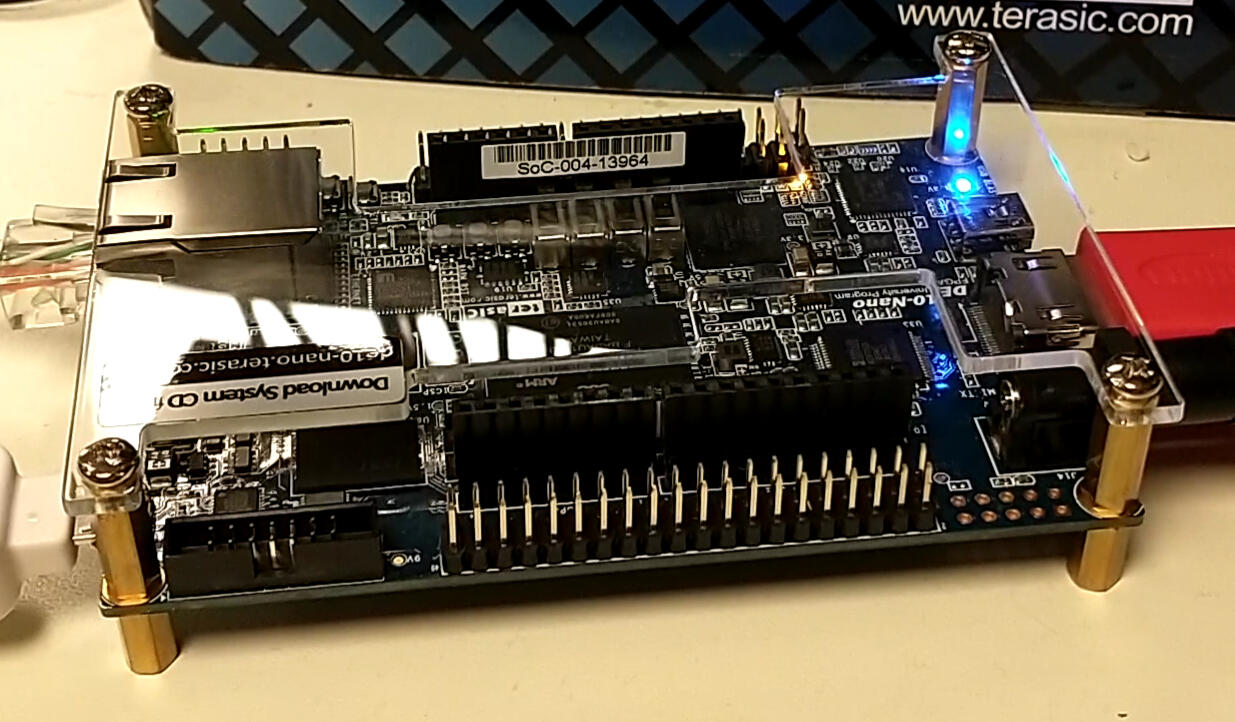
A De10 Nano with MiSTer installed on it, which the project runs on.
This video shows off a comparison of the first joystick movement I had with the finalized movement. On the right was my first attempt at using a joystick to control the player spot's movement, which simply draws the player at a position onscreen that corresponds to the position taken from the physical joystick.
Once I figured out how to pass the position of the joystick to the player spot, I altered my code to use that position to determine movement. Before that the game was controlled using a keyboard, but those controls were too discrete compared to the original console. The spot would either be moving or not, with no speeding up or slowing down. The joystick controls fixed that problem, since I could set the speed of the spot higher or lower based on the joystick's offset from its home position.
The switch to joystick based movement also helped me translate the feeling of playing the original game better. The controllers of the original Magnavox Odyssey contained 3 dials and 1 button. The dials corresponded to horizontal movement, vertical movement, and english (how much spin was placed on the ball). With the layout of the controller, it's impossible for players to turn all 3 dials at once. The control scheme for my Table Tennis core emulates this by using one joystick for vertical movement, one joystick for horizontal movement, and a toggle that will convert either joystick to the english control. Like on the original console, if a player wants to change the english on the ball, they will have to give up one of their axes of movement.
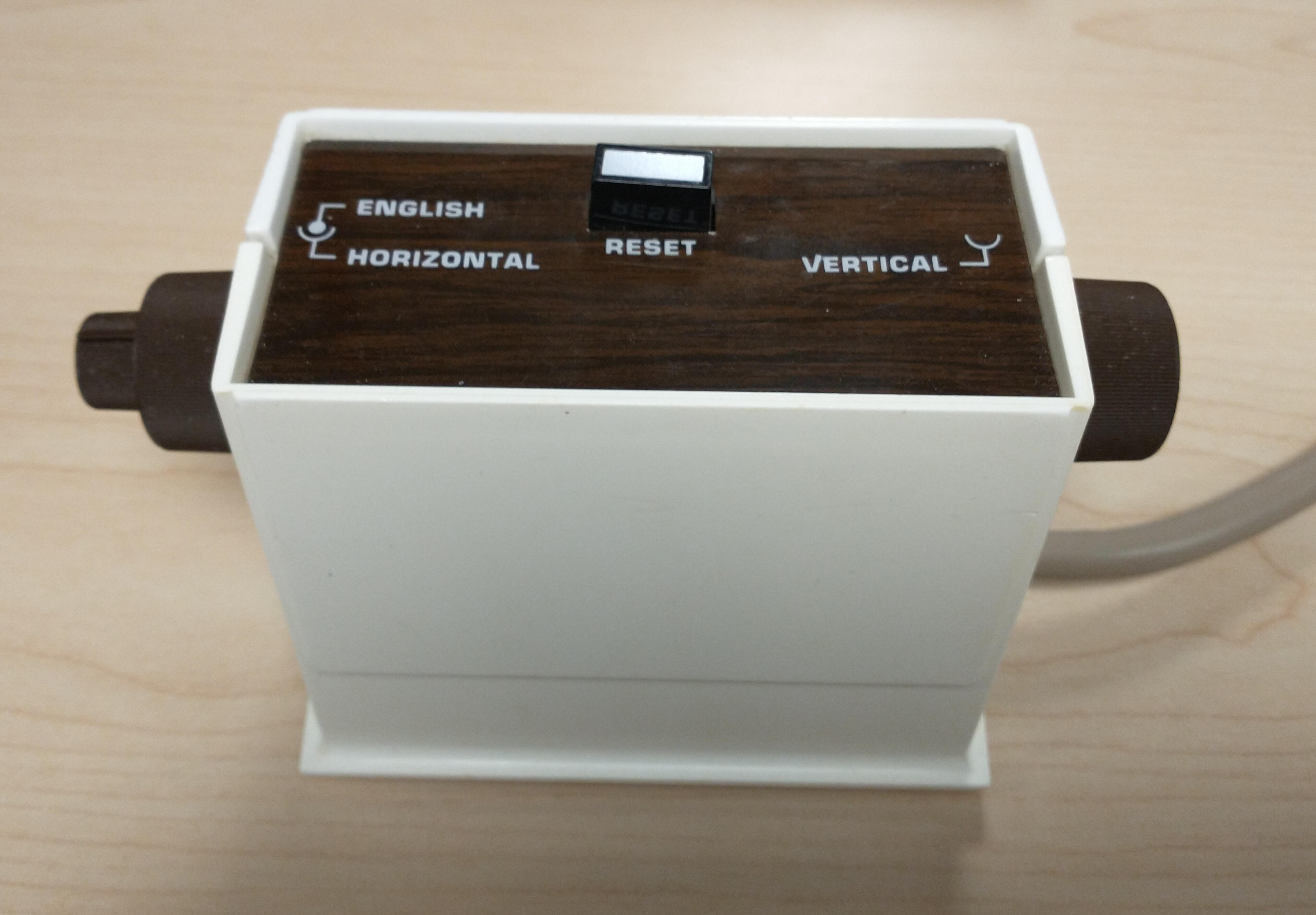
The original Odyssey controller.
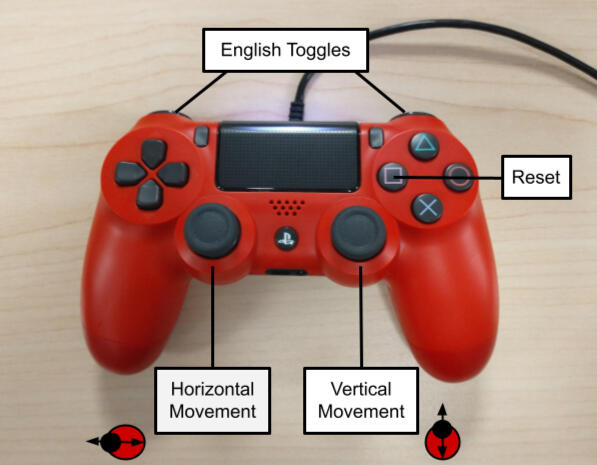
The Odyssey controls translated to a PS4 controller.
About Me
I studied Game Programming at Champlain College. I enjoy trying out new coding languages and learning new techniques.
When I'm not working, I enjoy sewing, drawing, and playing Dungeons and Dragons with friends.
Skills:
C++, C#
Unity
Git, GitHub
Jira, Confluence, BitBucket
Visual Studio
Interests:
Assembly
Verilog
Java, Javascript
Contact
You can find me at the links below!